

The Best Inventory Storage Strategies For Small Businesses
Your inventory is what keeps your business running. It comprises all the materials and products that make your shop unique and keep customers coming back. That’s why proper inventory control and stockroom organization are key to successfully running your business. Below, you’ll find several tips for storing your inventory and making the most of your space.
What Is Inventory Storage?
Inventory storage is designed to help business owners hold, track, and manage the items they sell. It goes beyond building some shelves or renting a warehouse. It’s a whole system that prioritizes careful organization to ensure items aren’t lost, smart layouts for quick order fulfillment, an internal organization system to track your items, and many more moving parts that make inventory storage work for your business.
Why Is Inventory Storage Important?
It keeps merchandise organized
With good organization, you won’t be left guessing if there’s another box of succulent planters in your back office or if you stashed the vanilla-scented candles behind its display. Each item will have its home, where it can be easily located for restocking, shipping, or tracking how much of that item is sold.
With organized inventory management, you’re not limited to carefully labeled aisles and bins – although there’s certainly nothing wrong with that. You can make inventory storage part of your displays, incorporating boxes of materials in creative ways alongside the items on the shelf
It can help minimize theft
Business owners need to have a plan in place to minimize employee theft. However, with a well-managed system, misdeeds are less likely to go unnoticed. Proper inventory storage can be an effective signal to employees who may think they can get away with pocketing a makeup palette or a phone charger, as it shows that someone’s keeping a close eye on the merchandise.
Inventory storage is essential for accurate stock counts
You’ll need to know where your items are kept to properly account for them. To that end, well-planned and highly organized inventory management simplifies this important process. You’ll save precious time and effort chasing down where items may be kept, and you’ll know precisely where each item is stored to ensure each SKU is accurately accounted for.
Power Up
Run stock counts like a pro using our guide, What Are Cycle Counts And Why You Should Be Doing Them.
Before you go about dividing your inventory, you’ll need to make sure you’ve mastered your inventory management system. Can you add traveling inventory to your current inventory records system? Do you conduct regularly scheduled inventory checks and updates?
Without an already established inventory management system, you could be adding chaos to your business by storing your traveling inventory separately. However, if you’re already crushing the inventory management process, separately storing your traveling inventory can enhance your business’s stockroom organization.
Best Practices
1. Free up floor space
Certain storage solutions and stockroom organization methods are ideal for increasing and optimizing your storage space. Remember those wall shelves? They’re a great option if you need to maximize space and storage capacity, no matter how big or small your storage area. Adding shelving to expand vertically could double or triple your usable retail stockroom space without adding to your overhead. Unused vertical space keeps your floor space clear of any obstructions while ensuring merchandise stays tucked away, organized, and secure.
2. Store by season
If some of your merchandise is seasonal, move it to the least accessible place in your storage during the off-season. If you don’t have much storage space, a small cost effective solution may be to rent a small storage unit that can hold the summer pool floats during the winter months, or keep the hot drink mugs out of sight in the summer. Just remember to set a calendar reminder so you don’t forget to haul everything out when the time comes.
3. Get the right software
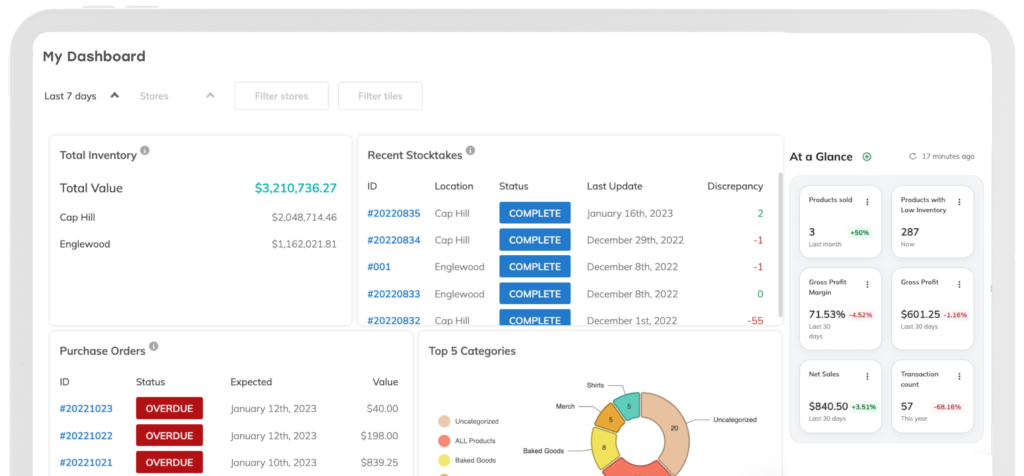
Precise organization is certainly the core of inventory storage, but the right software can make more complicated tasks a lot easier to handle. Inventory software is an incredibly valuable tool for knowing at a glance where inventory is stored, how much is left, and tracks incoming items so you know what to expect, and most importantly, where it belongs.
Try Inventory Management Free For 14-Days
Thrive Inventory stock counts keep your team organized with real-time stock counts. Set up multiple inventory locations for your store floor, back office, and warehouse so you always know exactly where your products are.

What Are The Best Methods For Organizing And Tracking Inventory In Storage?
Not overbuying
It can be easy to stock up on too many items – even in your personal life, not just business. Think about all the times you needed groceries and, instead of making a list, you walked around the store trying to remember what you needed. Once you started putting up the groceries at home, you might have realized you forgot to get the items you needed. You probably also bought some items you didn’t really need.
The same concept applies to purchasing inventory. If you add items to your cart before assessing your inventory and planning your resupply, you could end up overbuying. A more consistent and cost-conscious approach to inventory control would be knowing exactly what you need. This way, you’re not buying unnecessary or extra items that you need to find space for in your retail stockroom. That’s less room available for your bestselling products.
Take back control of your inventory with our free kit
Is your inventory controlling you? Use our tips, tricks, and tools to run your business confidently.
Tracking excess inventory
You might not be sure just how many customers you’ll see from one month to the next. As a result, you might order or create more products than you really need. But excess inventory can take up lots of space in your retail stockroom, so you should track your excess inventory. Doing so can help you locate products when you need them and make sure you’re optimizing every bit of storage space.
Using an inventory management system can help with inventory control. A good system – whether a detailed spreadsheet or an online management tool – can tell you exactly how many excess products you have on hand at any given time. And if you happen to buy and have excess inventory, you can create a dead inventory report, which tracks the inventory you’re storing that hasn’t sold recently. With this information, you can more easily determine what products you should order on your next resupply and which ones you shouldn’t buy.
Cycle counts
Running your business takes a lot of work, especially if you have a small team. And when your team is thinly spread, combing through every part of your inventory might not seem like a priority. However, without knowing the products in your inventory, you could be recording inaccurate inventory notes or ordering too many items. You could even be letting products expire and (worst of all) wasting money.
If you’re ready to really start tracking and organizing inventory, cycle counting is a viable solution. Cycle counting is the process of making small, regular adjustments to your inventory counts. These regular inventory counts can help you manage inventory by keeping accurate tallies of your best selling products, in-demand products, and anything else you sell. It can also keep products from expiring and prevent you from ordering too many products.
Storing Inventory With Growth In Mind
Having a small business often means not having a large stockroom, especially for storing inventory. At the same time, you still need enough space to keep up with demand as your business grows. Whether you keep some boxes in the corner of your home office or rent shelves in a warehouse, your inventory needs dedicated storage locations that keep you organized.
The Newsletter For Small Businesses
Weekly expert insights, industry trends, and inspiring stories designed to help you run your business with confidence.
The Only Inventory System That Actually Helps You Run A Healthy Business
Thousands of customers all over the world use Thrive Inventory to run a healthy business.
Thrive Inventory gives you control over all your inventory, sales channels, and metrics, allowing you to make the right decisions at the right time.
Keep Reading




The Newsletter For Small Businesses
Weekly expert insights, industry trends, and inspiring stories designed to help you run your business with confidence.
Try Thrive Inventory For Free
Add Thrive to your business and maximize your potential. With powerful and easy-to-use products,
it’s time to take control of your business and see what you can do with Thrive.